

The Jedi Mind Trick We Need for Workplace Accessibility Awareness

Accessibility Has a Branding Problem
For a lot of people, the moment they hear the word accessibility, their mind goes straight to one thing.
A wheelchair ramp. A disabled car park. Maybe a lift button.
All important, of course. But accessibility is much broader than that.
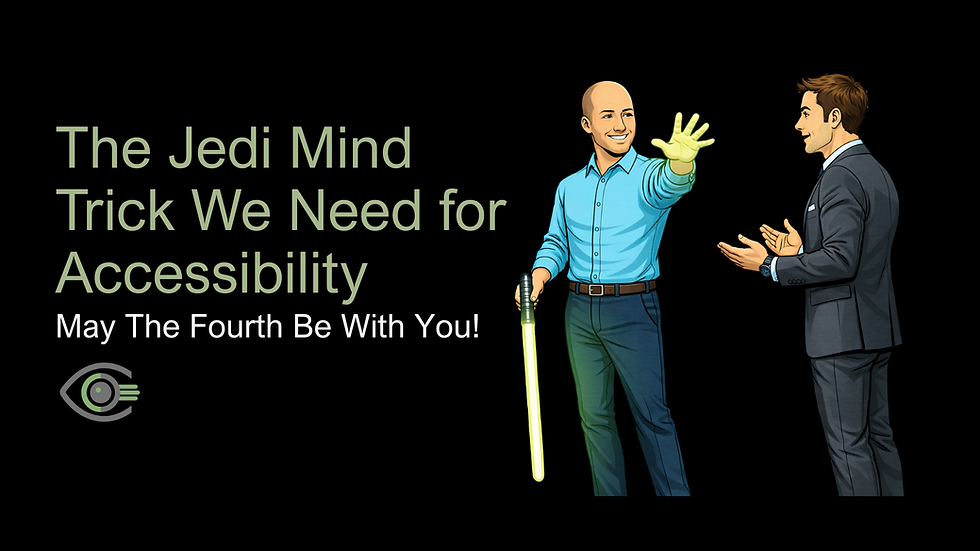
Sometimes I find myself wishing I could wave my hand like a Jedi and say, “This is not the narrow view of accessibility you are looking for.”
Too often, that narrow view is exactly what gets in the way.
What People Do Not See
I live with visual impairment, but from the outside I do not necessarily look visually impaired.
There is no obvious visual cue that tells people what I deal with day to day. Every new interaction can start from the same place. I have to explain. Again.
I have to explain why I may need information presented differently. Why a layout that looks clean and clever to someone else may be difficult for me to use. Why lighting, contrast, font choice, screen setup, digital structure, and the way information is shared can all make a real difference.
I have to explain that accessibility is not always visible, and disability is not always obvious.
That repeated explaining can be tiring.
The Cost of Constant Explaining
This is not always because people are unwilling. Often, it is because they are still working from an outdated picture of what accessibility means.
They are looking for the obvious signs. When they do not see them, they assume everything is fine.
When they see someone who is working, speaking confidently, turning up, contributing, and getting on with things, they may not realise that extra effort is happening quietly in the background every single day.
That is where the Jedi mind trick would come in handy.
Imagine if, instead of thinking accessibility means major building changes for a small number of people, more colleagues instinctively thought:
Accessibility is about making work usable, understandable, and inclusive for a wide range of people in a wide range of situations.
That would change a lot.
➡ It would change how meetings are run.
➡ It would change how documents are written.
➡ It would change how systems are designed.
➡ It would change how quickly people stop and ask, “What would make this easier to use?”
Most importantly, it would change the burden placed on people like me.
When Awareness Is Too Narrow
When awareness is low, the person with the access need has to do the extra work.
We have to translate our experience for others. We have to make the invisible visible.
We have to explain that struggling with glare, poor contrast, cluttered layouts, inaccessible PDFs, tiny text, unclear navigation, or badly structured documents is not a preference issue. It is an access issue.
When that conversation happens over and over again, it can start to feel like accessibility only exists when someone is prepared to disclose, justify, and educate.
That is not a good model.
A better model is one where people think more broadly from the start.
Workplace Accessibility Awareness Is Broader Than Most People Think
In a better model, accessibility is understood as part of workplace experience, not a side topic.
Teams understand that some barriers are physical, some are digital, some are procedural, and some are cultural.
People understand that invisible disability is still disability, and that support should not depend on whether someone “looks” like they need it.
That broader thinking matters because workplace accessibility awareness is not just about permanent conditions.
It also affects people who are temporarily injured, mentally overloaded, ageing, stressed, new to a system, working remotely, using a phone in bright sunlight, dealing with fatigue, or simply trying to make sense of confusing information.
In other words, accessibility is not a niche issue. It is a human one.
Why Appearances Are a Poor Test
From my perspective, one of the most frustrating things is not always the barrier itself.
Sometimes it is the surprise people show when I mention I am visually impaired. That moment of recalculation. That pause where they are trying to match what they assumed with what I have just told them.
It is a reminder that people often rely too heavily on appearances.
Accessibility was never meant to be judged by appearances. It is meant to be judged by experience.
➡ Can a person use the thing?
➡ Can they understand the information?
➡ Can they participate fully?
➡ Can they do so without unnecessary effort, embarrassment, or repeated explanation?
That is the real test.
The Shift Workplaces Need
Perhaps the Jedi mind trick we need is not magic at all.
Perhaps it is simply better awareness, built early and reinforced often.
We need colleagues and leaders to think beyond the stereotype.
We need organisations to stop treating accessibility as a specialist afterthought.
We need workplace design, communication, systems, and culture to reflect the fact that access needs are varied, and not all of them are visible.
We also need to make it easier for people to be understood without having to begin every new interaction with a personal explanation.
While I can explain my visual impairment, I should not have to keep proving that accessibility applies to me.
The goal is not sympathy.
The goal is not special treatment.
The goal is a workplace where broader thinking comes first.
That is the real mind trick worth learning.
Want to Go Deeper?
Scenarios like this are common, but they are often overlooked because they feel ordinary. Learning to spot them, and knowing how to respond well, is a core part of building more inclusive workplace experiences.
BlindSpot Solutions offers a range of Accessibility Awareness services designed to support this in practice, including workshops, workplace reviews, the Accessibility Awareness Playbook, and the Accessibility Awareness Learning Program.
If you would like to explore how this could apply in your organisation, you can submit an enquiry form, send an email, or browse the website to learn more.

